
Understanding Introversion: Definitions, Benefits, and Practical Guidance
Introvert or Extrovert Personality Test
Get StartedWhat Does It Mean to Be an Introvert?
People often imagine introverts as shy hermits, yet the core idea is simpler: it’s about how someone manages stimulation and replenishes energy. Instead of seeking constant buzz, many individuals focus inward, prefer meaningful conversations, and select environments with fewer interruptions. This style can look quiet in crowds and highly expressive in small, trusted circles. It is not a flaw, a diagnosis, or a rigid identity; it is a preference pattern that shows up in social choices, work rhythms, and daily planning.
In everyday conversation, many people ask, is introvert a personality in psychology or simply a social preference that varies by context and culture. The most accurate framing places introversion on a continuum, where intensity, needs, and behaviors shift across situations. A person can love people yet still need solitude to feel fully restored after a busy day.
Within clinical literature, the phrase introverted personality usually refers to patterns of attention, sensory sensitivity, and the way someone recharges after interaction. That lens helps explain why a book, a walk, or a quiet studio can feel nourishing. By naming these tendencies, people gain language to advocate for conditions that help them think clearly, create, and connect without burning out.
The Spectrum of Social Energy
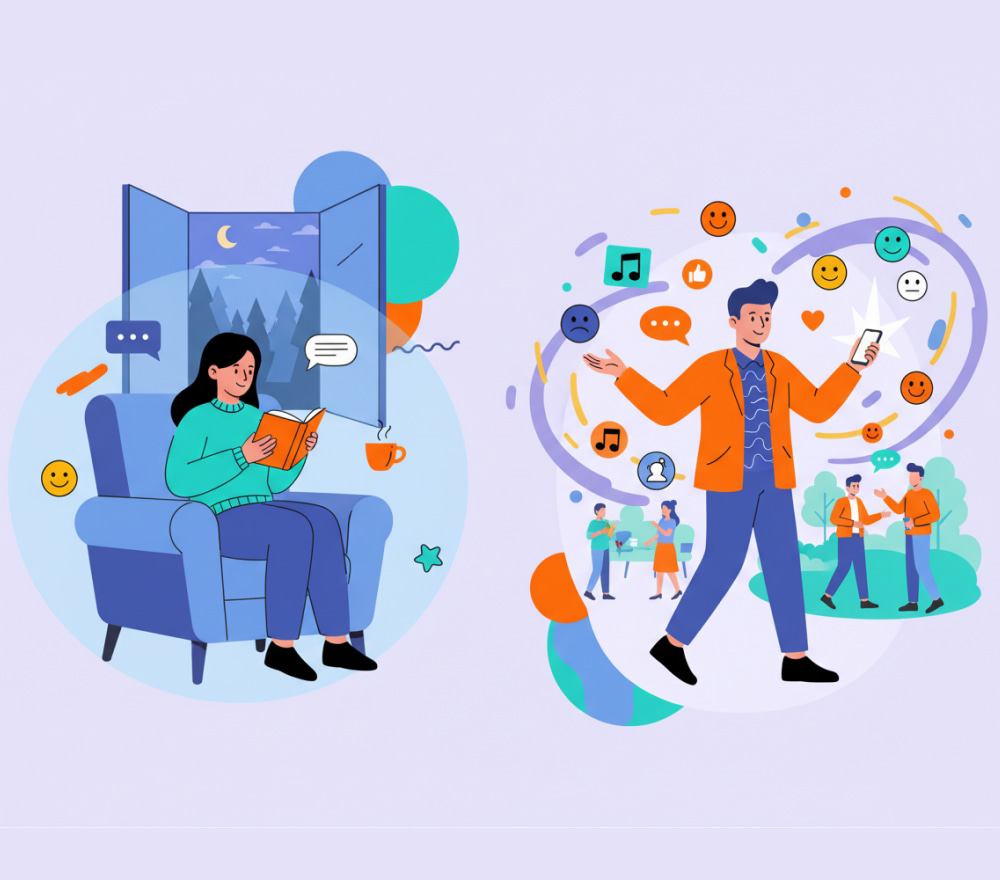
Psychology views social energy as fluid rather than binary, and many frameworks describe clusters of preferences instead of boxes. Researchers sometimes outline families of preferences, sometimes called introvert personality types, noting variations in sociability, sensitivity to noise, and preferred group size. Even within the same household, one person may seek long, reflective stretches while another prefers lively, fast-paced engagement. Both can be healthy and effective when needs are acknowledged.
At the other end of the continuum, a classic extrovert personality often gains momentum from frequent interaction, novelty, and visible collaboration. These individuals might think out loud, enjoy rapid feedback, and find energy in spontaneous exchanges. Neither end is superior; both add value to teams, families, and communities when space is made for different pacing, recovery styles, and communication methods.
- Social energy changes with sleep, stress, and the stakes of a situation.
- Context matters: a person may be outgoing at home and reserved at work.
- Environment shapes behavior; lighting, noise, and crowd density all matter.
- Language can mislead; “quiet” does not equal “unfriendly,” and “talkative” does not equal “inattentive.”
Everyday Situations: a Practical Comparison
Applying the concept to real life helps more than abstract labels. Consider how different settings impact mental bandwidth and engagement. Open offices can drain focus; remote work can isolate; brainstorming can inspire or overwhelm depending on structure. Designing small, specific adjustments makes a profound difference, especially when groups agree to norms about meetings, deep work, and recovery time. With a shared toolkit, people collaborate better without forcing uniform behavior.
| Situation | Typical Stressor | Helpful Shift for Quiet‑leaning | Helpful Shift for Outgoing‑leaning |
|---|---|---|---|
| Open office layout | Continuous noise and interruptions | Noise-canceling zones and focus blocks | Collaboration pods scheduled by project |
| Large brainstorming meeting | Fast pace and idea pileups | Pre-reads and written ideation time | Live facilitation and quick rounds |
| Networking event | Surface chatter and time pressure | Arrive with goals and exit cues | Roaming introductions and warm handoffs |
| Remote sprint | Isolation and unclear signals | Async updates and quiet hours | Frequent stand-ups and co-working rooms |
| One-on-one mentoring | Mismatch in communication styles | Agenda shared ahead of time | Live whiteboarding and quick feedback |
Across work and home, you can observe introvert and extrovert personality traits by watching recovery habits, conversational timing, and preferred group size. When teams normalize options, like choosing chat, email, or meetings based on the task, everyone contributes more consistently. Respecting different recharge cycles often reduces friction and increases sustained performance.
Benefits of Introversion in Work, Learning, and Life
Quiet strengths often go unnoticed because they unfold over time rather than in dramatic bursts. For creativity that demands depth, an introverted personality type can excel by sustaining attention, spotting patterns, and synthesizing complex information. These individuals frequently build trust through reliability, prepare thoroughly, and communicate with precision. In research-heavy roles or crafts requiring meticulous care, this steadiness becomes a competitive edge.
In cross-functional settings, it helps to map complementary talents so that contributions are visible. On collaborative projects, an extrovert personality type might accelerate momentum by energizing group dialogue, while a quieter partner curates insights and stress-tests assumptions. When leaders design rituals that balance airtime and reflection, the group captures both speed and accuracy, reducing the risk of groupthink while maintaining decisive action.
- Focused attention supports complex problem solving and long-term planning.
- Careful listening improves conflict resolution and client discovery.
- Preparation creates clarity, which saves time in execution.
- Thoughtful boundaries protect energy, enabling consistent results.
How to Discover Your Orientation
Self-knowledge begins with noticing how you feel before, during, and after social activity. Journaling about energy levels can reveal patterns that labels alone may miss. Online assessments labeled personality test introvert extrovert offer quick signals, but the real value comes from comparing results with lived experience over weeks and months. If an answer surprises you, treat it as a hypothesis to explore rather than a verdict to accept.
When you want greater accuracy, look for instruments with published reliability and clear explanations. A validated personality test for introvert extrovert should disclose scoring methods, give neutral feedback, and suggest practical experiments for work and relationships. Pair measurement with reflection by noting which environments foster your best thinking, how breaks affect quality, and what rituals reset your attention for the next task.
- Track energy before and after meetings for two weeks.
- Experiment with protected focus blocks and compare output.
- Schedule social time intentionally, then assess your recovery needs.
- Share preferences with colleagues to co-design better workflows.
Collaboration and Relationships Across the Spectrum
Healthy teams and friendships make room for multiple ways of engaging, from lively debate to quiet drafting. In practice, most adults show a blended introvert extrovert personality profile that shifts with context, stakes, and fatigue. The goal is not to “fix” anyone but to align tasks with strengths, set transparent norms, and rotate roles so that facilitation, documentation, and decision-making don’t fall on the same people every time.
Leaders who calibrate meetings, space, and communication channels will notice stronger contributions from everyone. Team leads should note that extroverted personality types tend to thrive in fast ideation and real-time collaboration, while quieter colleagues shine when given time to develop drafts or analyze trade-offs. A culture that honors both speeds prevents burnout and keeps innovation pipelines healthy.
For many, there is comfort in the middle ground between solitude and social buzz. Some people self-describe as an introverted extrovert personality type, signaling flexibility around people coupled with a need for restorative downtime later. The language is less important than the agreements you set about calendars, deadlines, and boundaries that let each person contribute at their authentic best.
Faq: Common Questions About Introversion
Is introversion the same as shyness?
No. Shyness involves fear of judgment, whereas introversion concerns how you manage stimulation and recover energy. An introvert can be confident on stage yet still prefer a quiet evening after the event. Likewise, a socially bold person can be shy in new settings. Asking how an activity affects energy levels is a clearer gauge than labeling behavior in a single moment.
Can someone change from introvert to extrovert?
Core preferences are relatively stable, but behavior is highly adaptable. People learn skills that help them operate across contexts, such as public speaking, facilitation, or deep-focus routines. Think of it like dominant and secondary strengths: you can expand your range without needing to abandon your natural recovery style.
How can introverts communicate their needs at work?
Start by describing what helps you do your best thinking: protected focus blocks, agendas before meetings, or asynchronous updates. Propose small experiments with clear success metrics, such as fewer meetings or shorter stand-ups. When colleagues see results, better decisions, fewer reworks, they usually support maintaining the practices.
What environments support introverted strengths?
Spaces with adjustable noise, good lighting, and control over interruptions tend to help. Hybrid setups that alternate deep-work days with collaborative days can preserve attention without isolating people. Digital tools that reduce context switching, like batching notifications, also protect concentration and improve overall quality.
What are simple daily habits that help?
Plan recovery time after high-interaction tasks, and schedule creative work when energy is highest. Use prep notes to streamline meetings, and set boundaries on messaging to avoid constant pings. Short walks, breathing breaks, and intentional transitions between tasks help reset focus and maintain steady momentum throughout the day.